Apr3nDamos (Let’s learn)
Date: 2021 09th June
Place: Escuelas pías Jaca
Email: enriquesubiras@escolapiosemaus.org
Areas:
- Enfoque global-local
- Sostenibilidad
Age:
-
- 6-8 years
- 8-10 years
- 10-12 years
- 12-14 years
- 14-16 years
Objectives :
Our aim is for our students to learn how a 3D printer works, to design their own objects and to print them. At the same time, we want their learning to help others.
Recursos: https://www.escolapiosjaca.org/apr3ndamos/
Valoración:

Apr3nDamos is our 3D Printing and Service-learning project. Our aim is for our students to learn how a 3D printer works, to design their own objects and to print them. At the same time, we want their learning to help others.
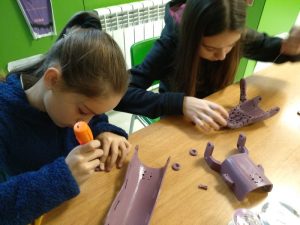
We devote the first session to showing how a 3D printer works, what parts it has and how it turns the filament into the object we want to print.
In the following sessions, we explain how to use the Tinkercad programme. They will learn how to design their own 3D objects to print them with it. The design is done in pairs or teams, making a first sketch on paper, taking into account the 3 dimensions, to then design it with this programme. Using this programme will allow them to design any object they can think of.
We want the learning they achieve in this project to be used to help other people and show them how, through new technologies, we

can also help others. In this way, with the designs they make and print, they collaborate in making key rings, bookmarks, pendants, pencil holders… to sell at the charity markets we hold at school. Also, trophies for the tournaments or competitions we hold; toys or musical instruments… but we don’t want to stop at just doing things for the school. That’s why we collaborate with different initiatives and NGOs.
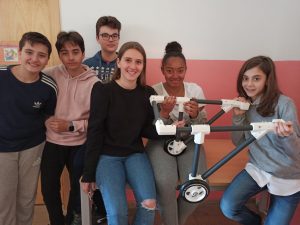
Secondary-school pupils have been able to design and assemble a wheelchair for dogs that have lost mobility in their hind legs, thus making it easier for them to move.
We collaborate with the NGO Ajedrez sin Fronteras. This non-profit-making organisation aims to spread chess and all the values i
t transmits, especially among people who are living in the most disadvantaged situations of poverty, war and injustice.
Our way of collaborating with this NGO is by designing and printing chess pieces to send complete sets to refugee camps, such as the one in Lesbos, in Greece, or in Tindouf in, Algeria, where women and teachers are being trained hard so that they can teach the little ones. With our games, more children will be able to enjoy chess and all that it transmits.
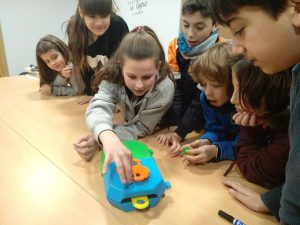
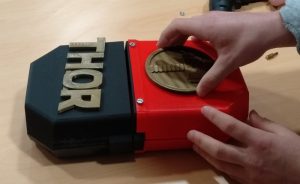
With our service-learning project, we have printed and assembled several Chemoboxes, a box printed with a 3D printer, inside which the serum for the chemotherapy treatments given to children with cancer is kept. We decorate them according to the children for whom it is int
ended tastes to make the time of the treatment a more cheerful and motivating moment.
Chemoboxes were born in Brazil, thanks to an advertising campaign by a commercial agency three years ago. This project reached Spain on 25 February 2018, when a father —Twitter user Batmandonamedula— asked on this social network if someone could tell him how to get one of
these boxes for the treatment of his sick son. One of the first to reply was Pepo Jiménez, who designed a box to which he has been making different improvements. Celso Frade and Guillermo Martínez also began to make their designs. We have taken their designs to print the ones we gift. Nowadays, many people, institutions and we have joined this cause, and, with our printers, we print the chemoboxes altruistically and donate them to children with cancer.
As we want it to be a centre project, when we deliver the chemoboxes, we accompany it with one or more drawings or letters from the youngest pupils to encourage the person who receives the box.
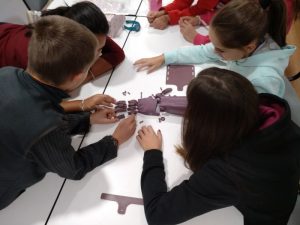
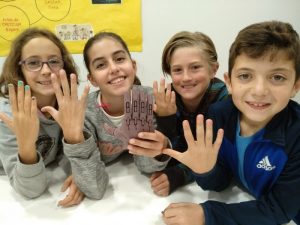
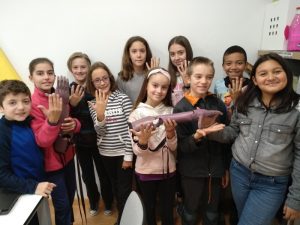
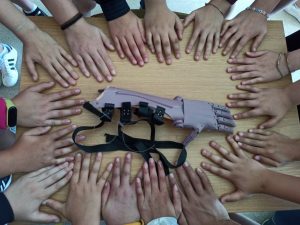
We also collaborate with the NGO Ayúdame3D, manufacturing trésdesis, which are 3D printed prosthetic hands and arms for people witho
ut resources anywhere in the world, improving their quality of life.
This NGO was born in Spain, in the bedroom of a twenty-something who wanted to find a charitable use for his printer. Today, Guillermo Martínez, its founder, and helpers like us have helped more than 150 people in 35 countries.
Our trésdesis have travelled to Lebanon, Cuba, Guatemala, Brazil, India, and Almeria (Spain). As Guillermo Martínez, founder of Ay
údame3D, says: “Helping is too easy not to”. At Piarist of Jaca, we want our students to make this message their own and live it, showing them how, through new technologies and with our passions and hobbies, we can help people in need.
Our project “Apr3nDamos” would not be possible without the collaboration of the Itaka-Escolapios Foundation, which donated spools of PLA filaments, the material we use to print on the 3D printer. PLA or polylactic acid is a biodegradable polymer derived from lactic acid. It is mad
e from 100% organic and renewable resources such as corn, beets, wheat, and other starch-rich products. It has very similar properties to petroleum-derived plastic materials such as PET but does not contaminate and does not release toxic gases when melted for printing.
This is how we explain what this project consists of, at the 2nd MIAC (Innovative Teachers, Competent Students) Conference.